„Rund 30 000 E-Autos mit einem Gesamtwert von rund zwei Milliarden Euro dürften allein in den ersten neun Monaten des vergangenen Jahres als junge Gebrauchtwagen ins Ausland verkauft worden sein“, sagt Stefan Bratzel, Automobilwirtschaftsprofessor und Direktor des Center of Automotive Management (CAM) in Bergisch Gladbach.
Für Autoexperte Stefan Bratzel ist klar: Die Transformation der Autoindustrie wird zu einigen unschönen Verwerfungen führen. Autobauer müssten daher bei Software oder Elektromobilität Fahrt aufnehmen, um die eigene Zukunftsfähigkeit zu garantieren.
Herr Bratzel, in ihren Auswirkungen auf die Branche hat die Halbleiterkrise die Coronapandemie noch in den Schatten gestellt. Muss die deutsche Autoindustrie sogar um ihre Zukunftsfähigkeit bangen?
Tatsächlich ist die Situation gar nicht so dramatisch, wie man vielleicht annehmen könnte. Vielmehr ist sie zwiespältig: Auf der einen Seite erleben wir gerade massive Absatzeinbrüche im Vergleich zu Zeiten vor der Pandemie, auf der anderen Seite fahren die Autohersteller momentan zum Teil hohe Gewinne ein. Das liegt daran, dass vor allem höherpreisige Fahrzeuge aus dem Premiumsegment verkauft wurden und gleichzeitig einiges an Kosten gespart wurde.
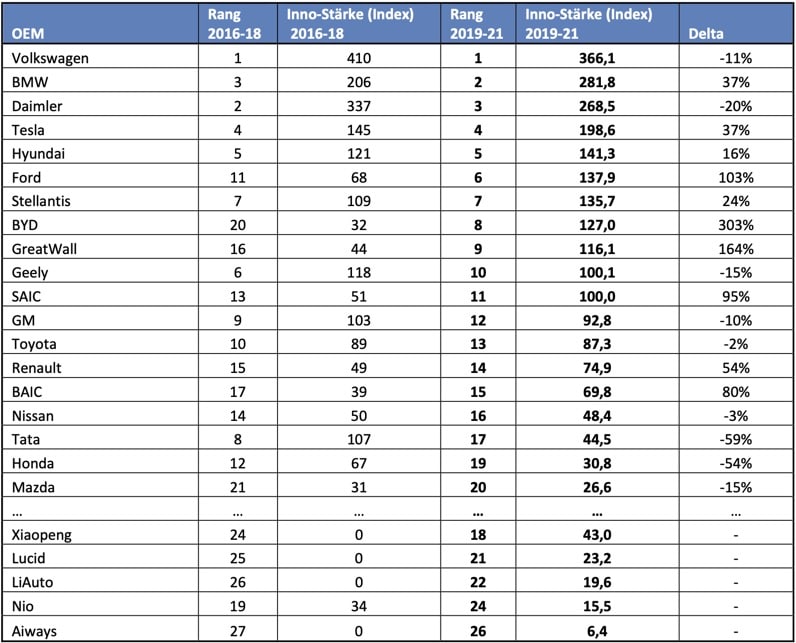
Volkswagen, BMW and Daimler as well as Tesla have remained the most innovative global automotive groups in the multi-year analysis since 2016, ahead of Hyundai, Ford and Stellantis. With BYD, Great Wall and Geely, three Chinese OEMs made it into the top 10 for the first time. Overall, the Chinese automobile manufacturers have been among the big winners in recent years and can significantly increase their innovation performance. The Japanese manufacturers in particular are losing their innovative strength, with the world’s top-selling OEM Toyota only ranking 13th. At the same time, automotive start-ups such as Xpeng, Nio, Rivian and Lucid are pushing their way into the world market with a high degree of innovation. These are the core results of the current AutomotiveINNOVATIONS study by the Center of Automotive Management (CAM) in Bergisch Gladbach, which assesses the vehicle-technical innovations of 30 automobile groups with over 80 automobile brands. The long-term comparison is based on around 2,900 innovations that were introduced in series models between 2016 and 2021 (first half of the year). All innovations were evaluated according to quantitative and qualitative criteria (MOBIL approach, see below).
German OEMs occupy podium places
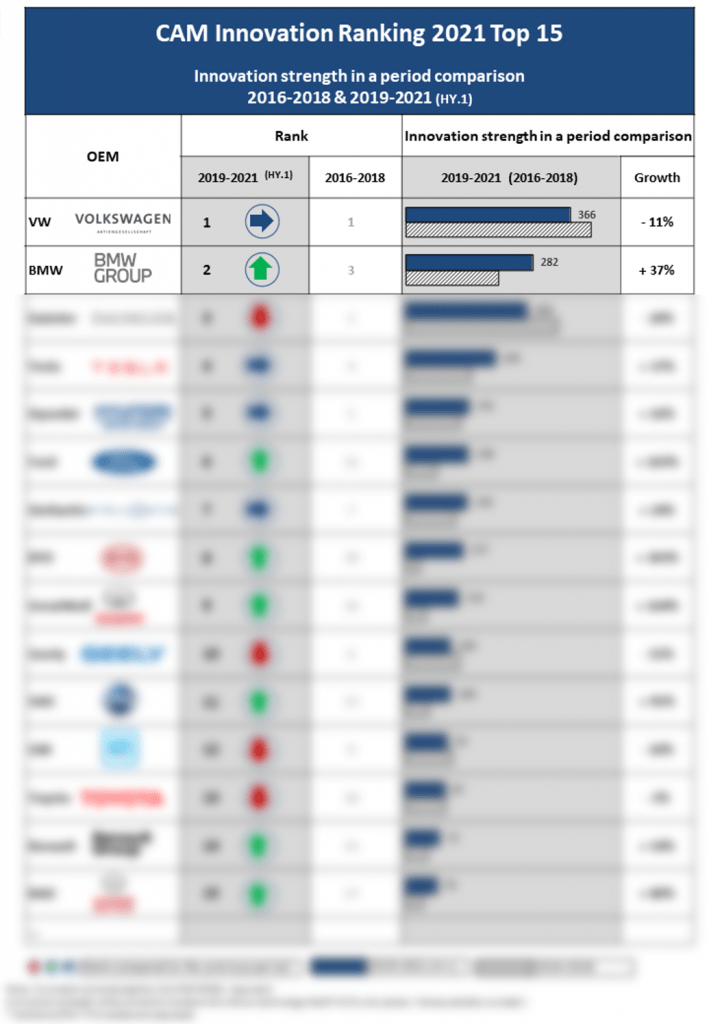
The German automobile manufacturers have so far been able to maintain their strong innovation performance even in the transformation phase of the industry since 2015. The Volkswagen Group with the core brands VW, Audi and Porsche is ahead in the innovation ranking with 366 (and 410) index points despite a slight decline in both comparison periods (2016-18 and 2019-21) (see Fig. 1). The innovation performance in the years 2019-21 will be supported in particular by innovations in the technology fields of electric drive as well as interfaces and display concepts.
BMW moved up to second place among the most innovative manufacturers with 282 index points (+ 37%) and ousted Daimler to third place in a head-to-head race. During this period, BMW generated 125 world and group novelties ready for series production, such as the active traffic light assistant of the Urban Cruise Control System, which independently detects red traffic lights and comes to a standstill in front of them. With the launch of its new Mercedes-Benz S-Class (2020), Daimler is presenting numerous innovations such as the MBUX interior assistant or the digital light, which can warn of construction sites using symbols projected on the street, among other things. Overall, the Stuttgart-based company is just behind its core competitor with 118 identified and individually assessed world and group innovations.
Figure 1: Innovative strength of global automobile manufacturers (group level) – Ranking Top 15
Source: CAM
Tesla and Hyundai dominate midfield, while Ford and Chinese OEMs are the most innovative drivers
The US electric car manufacturer Tesla achieved a strong fourth place in both observation periods despite only four models in series production. With world firsts from the technological fields of electric drive (e.g. range optimization Model S) and driver assistance systems (e.g. Navigate on Autopilot Model 3) ready for series production, Tesla can even increase its innovative strength by around 37 percent. Hyundai can assert itself in fifth place with innovations such as the best power consumption value of the Kia e-Soul (2019) in the minivan segment. However, the gap between the South Koreans and Tesla and the top 3 has widened somewhat.
One of the biggest winners in the period comparison is surprisingly the US company Ford, which moved up to 6th place and improved by five places. In total, since 2019, Ford has produced around twice as many series innovations with more than 65 group and world firsts than in the first observation period. The main reasons for this positive development are innovative models such as the Ford Mustang Mach-E (2020), which sets new standards in terms of electric range in the medium-size SUV segment, or the Ford F-150 (2020), the world’s first Pick-up truck can receive new or improved assistance systems via Over-The-Air Updates (OTA).
In addition to Ford, the Chinese car manufacturer are gaining in importance in innovation ranking. With an increase in innovative strength of more than 300 percent, BYD is experiencing the greatest growth of all automobile manufacturers considered in the period comparison. A broad electric offensive is primarily responsible for this, as BYD already had a large number of purely electric vehicles (BEV) in various segments at an early stage (e.g. BYD Song PRO as a medium-size SUV, BYD Han EV in the upper middle class or BYD Song MAX as a minivan). In addition, BYD benefits from the Didi D1 developed in cooperation with Didi Chuxing (Chinese mobility provider), an electric vehicle of the lower middle class specially designed for ride-hailing purposes, which has special features such as a rainbow-colored “pick-up light”. In the second observation period (2019-21), Great Wall also increased its innovative strength significantly with a plus of more than 160 percent and brought series-ready world novelties onto the market, such as a gesture-based, autonomous parking function in the Wey Mocha (2021). SAIC is increasing its innovative strength primarily due to an expanded range of electric vehicles (e.g. Roewe Ei5, Roewe ER6 or Maxus T90) and thanks to the introduction of the Baojun E300, a fully electric mini car that can already drive semi-autonomously according to SAE level 2 as standard.
Study leader Stefan Bratzel: “Electromobility, connectivity and autonomous driving lead to a dramatic change that will reorganize the industry over the next 10 years. In spite of all prophecies of doom, the German automotive groups are currently very innovative and cover a wide range of technologies with their innovations. However, due to the high level of innovation, this positive snapshot is not a long-term guarantee of survival. Already today, Tesla and other newcomers, especially from China, score with a high level of innovation and put the established manufacturers under enormous competitive pressure. In the transformation phase of the industry, comprehensive competencies in the areas of electromobility, connected services and autonomous driving will become the decisive conditions for success and survival for automobile manufacturers. „
Geely, GM and Toyota lose their innovative strength and lose most of the places in the ranking
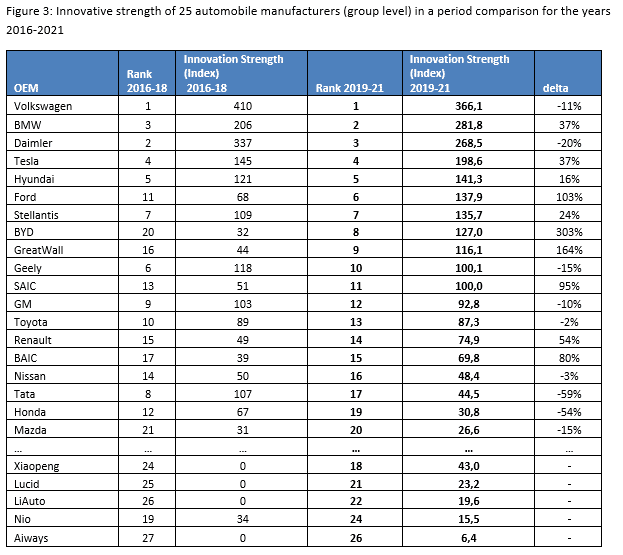
The biggest losers in the period comparison include Geely, which is the only Chinese company to show a decline in innovative strength in the second observation period, as well as General Motors (GM) and the large Japanese group Toyota. Geely, whose innovative strength is significantly influenced by the Swedish subsidiary brands Volvo and Polestar, was unable to maintain its very high level of innovation in the previous period and fell from sixth to tenth place. The US company General Motors cannot build on the innovative strength of the first period and has slipped from ninth to twelfth place. Despite the introduction of new, innovative models such as the GMC Hummer EV, which sets new standards with a maximum charging power of up to 350 kW, GM missed a place in the top 10 with an innovation performance that was down by around 10 percent. The example of Toyota shows that stagnation in a dynamic competitive environment makes it difficult to catch up with the competition. While other corporations have often been able to increase their innovative strength in the high double-digit percentage range, Toyota remains at about the same level of innovation as in the first period, slipping from tenth place to thirteenth. With Nissan and Honda, other Japanese manufacturers are deteriorating. While Nissan has dropped from 14th to 16th, Honda has lost 7 places and is now only 19th. Tata Motors, too, was unable to maintain the high level of innovation of its premium brands Jaguar and Land Rover in the previous period and slipped from rank 8 to 17.
Xpeng leads the newcomer innovation ranking ahead of US start-up Lucid
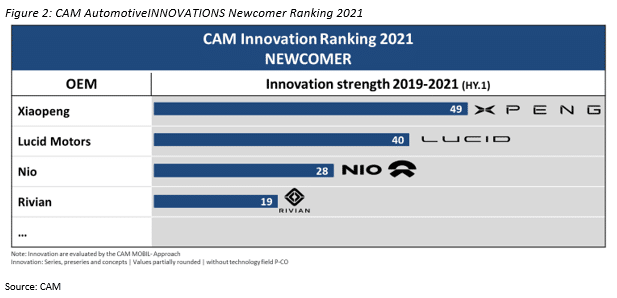
With the entry of Chinese and American newcomers, the global automotive market is fundamentally changing. Against this background, the CAM has created a separate newcomer ranking, which compares the innovative strength of the four electric start-ups Xpeng, Lucid, Nio and Rivian in the observation period 2019-21 (1st half of the year) (see Fig. 2). The Chinese automobile manufacturer Xpeng secured first place with world firsts in the key innovation field of connectivity (e.g. OTA-capable operating system Xmart OS in the Xpeng G3). With its only model to date, the Lucid Air, the US start-up Lucid Motors is setting new standards in terms of electric range (up to 830 km according to the EPA cycle), impresses with its high charging power (up to 300 kW) and is overall in second place. Nio, another Chinese player, brought a completely new approach to electromobility to the road with its battery change concept launched in 2018 and thus achieved third place. The EV start-up Rivian Automotive, supported by the large corporation Amazon, is in fourth place with a stock market valuation of over 80 billion US dollars and a previously marginal delivery volume.
Figure 3: Innovative strength of 25 automobile manufacturers (group level) in a period comparison for the years 2016-2021
Source: CAM
Methodology:
The aim of the CAM innovation study is to analyze the innovation trends in the automotive industry and the innovative strength of companies. Since 2005, between 600 and 1,200 technical vehicle innovations from automobile manufacturers have been recorded annually, each of which is classified according to around 50 defined criteria such as technology field, innovation type, model, etc. and are systematically assessed according to the M.OB.IL approach (Maturity, Originality, Benefit , Innovation level). The CAM defines innovations as novelties that offer new or additional customer benefits compared to the status quo. For example, world novelties that are available in series and have a high level of customer benefit are rated higher than me-too or group innovations that are only available as a pre-series or study (prototype). This results in an index value for every innovation, which can be condensed into total values for individual groups or brands. A methodology overview can be found here: http://www.automotiveinnovations.de/download/MOBIL-Approach.pdf
About the study:
The overall study AutomotiveINNOVATIONS 2021, which comprises more than 150 pages with more than 100 graphics, figures and tables, can be ordered for a fee at https://auto-institut.de/automotiveinnovations-2/. On the basis of over 600 categorized and individually assessed vehicle technology innovations of the year 2020/21 alone, it identifies the future trends of 30 automotive groups with 80 brands from Europe, Japan, the USA and China, among others.
About the CAM:
The Center of Automotive Management (CAM) is an independent, scientific institute for empirical automotive and mobility research as well as for strategic advice at the University of Applied Sciences (FHDW) in Bergisch Gladbach. CAM supports its customers on the basis of extensive databases, in particular on vehicle technology innovations in the global automotive industry as well as on the market and financial performance of automobile manufacturers and automotive suppliers. Using well-founded industry know-how and intimate knowledge of the market, CAM develops individual market research concepts and practice-oriented solutions for its customers in the automotive and mobility industries.
Volkswagen, BMW und Daimler sowie Tesla bleiben in der Mehrjahresbetrachtung seit 2016 die in- novationsstärksten globalen Automobilkonzerne vor Hyundai, Ford und Stellantis. Mit BYD, Great Wall, Geely kommen erstmals drei chinesische OEM in die Top-10. Insgesamt zählen die chinesischen Automobilhersteller zu den großen Gewinnern der letzten Jahre und können ihre Innovationsleis- tungen erheblich steigern. An Innovationskraft verlieren vor allem die japanischen Hersteller, wobei der weltweit absatzstärkste OEM Toyota nur noch auf Rang 13 kommt. Gleichzeitig drängen Auto- motive Start-ups wie Xpeng, Nio, Rivian und Lucid mit hoher Innovationsdynamik in den Weltmarkt. Das sind die Kernergebnisse der aktuellen AutomotiveINNOVATIONS Studie des Center of Automo- tive Management (CAM) in Bergisch Gladbach, die die fahrzeugtechnischen Innovationen von 30 Au- tomobilkonzernen mit über 80 Automobilmarken bilanziert. Basis des Langzeitvergleichs sind rund 2.900 Neuerungen, die zwischen 2016 und 2021 (1. Halbjahr) in Serienmodellen hervorgebracht wur- den. Die Bewertung aller Neuerungen erfolgte nach quantitativen und qualitativen Kriterien (MOBIL- Ansatz, siehe unten).
Deutsche OEMs belegen Podiumsplätze
Die deutschen Automobilhersteller können ihre starken Innovationsleistungen bislang auch in der Transformationsphase der Branche seit 2015 halten. Der Volkswagen Konzern mit den Kernmarken VW, Audi und Porsche liegt über beide Vergleichsperioden (2016-18 bzw. 2019-21) im Innovationsran- king mit 366 (bzw. 410) Indexpunkten trotz eines leichten Rückgangs vorn. (siehe Abb. 1). Die Innova- tionsleistung in den Jahren 2019-21 wird insbesondere von Innovationen in den Technologiefeldern elektrischer Antrieb sowie Bedien- und Anzeigekonzepte getragen.
Auf Rang 2 der innovationsstärksten Hersteller rückt BMW mit 282 Indexpunkten vor (+37%) und verdrängt in einem Kopf-an-Kopf-Rennen Daimler auf Rang 3. BMW generiert in dieser Periode 125 serienreife Welt- und Konzernneuheiten, wie dem aktiven Ampelassistenten des Urban Cruise Control Systems, welcher eigenständig rote Ampeln erkennt und vor diesen zum Stillstand kommt. Daimler, jetzt Mercedes-Benz Cars, präsentiert mit der Neuvorstellung seiner neuen Mercedes-Benz S-Klasse (2020) zahlreiche Neuerungen wie den MBUX-Interieur-Assistenten oder das Digital Light, welches u.a. durch auf Straße projizierte Symbole vor Baustellen warnen kann. Insgesamt liegen die Stuttgarter mit 118 identifizierten und einzeln bewerteten Welt- und Konzernneuheiten knapp hinter ihrem Kernwettbewerber.
Abbildung 1: Innovationsstärke der globalen Automobilhersteller (Konzernebene) – Ranking Top 15
Quelle: CAM
Tesla und Hyundai dominieren Mittelfeld, Ford und chinesische OEMs steigern Innovationskraft am stärksten
Der US-Elektroautobauer Tesla erreicht in beiden Betrachtungsperioden trotz weniger Baureihen einen starken vierten Rang. Durch serienreife Weltneuheiten aus den Technologiefeldern elektrischer Antrieb (z.B. Reichweitenoptimierung Model S) und Fahrerassistenzsysteme (z.B. Navigate on Autopi- lot Model 3) kann Tesla seine Innovationskraft sogar um rund 37 Prozent steigern. Hyundai kann sich mit Innovationen, wie einem Stromverbrauchs-Bestwert des Kia e-Soul (2019) im Segment der Mini- vans, auf dem fünften Platz behaupten. Allerdings hat sich der Abstand der Südkoreaner zu Tesla und den Top 3 etwas vergrößert.
Zu den größten Gewinnern im Periodenvergleich zählt überraschend der US-Konzern Ford, der auf Rang 6 vorrückt und sich um fünf Plätze verbessert. Insgesamt konnte Ford seit 2019 mit mehr als 65 Konzern- und Weltneuheiten rund doppelt so viele Serieninnovationen hervorbringen als in der ersten Betrachtungsperiode. Ursächlich für diese positive Entwicklung sind vor allem innovative Modelle wie der Ford Mustang Mach-E (2020), welcher in puncto elektrische Reichweite neue Maßstäbe im Seg- ment der Medium-Size SUV setzt oder der Ford F-150 (2020), der als weltweit erster Pick-up Truck via Over-The-Air Updates (OTA) neue oder verbesserte Assistenzsysteme erhalten kann.
Neben Ford gewinnen insbesondere die chinesischen Konzerne an Bedeutung im Innovationsranking. So erfährt BYD mit einer Steigerung der Innovationskraft um mehr als 300 Prozent das größte Wachs- tum aller im Periodenvergleich betrachteten Automobilhersteller. Verantwortlich dafür ist vor allem eine breite Elektrooffensive, da BYD bereits zu einem frühen Zeitpunkt eine Vielzahl an rein elektri- schen Fahrzeugen (BEV) in diversen Segmenten (z.B. BYD Song PRO als Medium-Size SUV, BYD Han EV in der oberen Mittelklasse oder BYD Song MAX als Minivan) hervorgebracht hat. Darüber hinaus pro- fitiert BYD von dem in Kooperation mit Didi Chuxing (chinesischer Mobilitätsanbieter) entwickelten Didi D1, einem speziell für Ride-Hailing-Zwecke konzipiertem Elektrofahrzeug der unteren Mittelklasse, das über spezielle Features wie einem regenbogenfarbenen „Pick-up-Light“ verfügt. Auch Great Wall legt in der zweiten Betrachtungsperiode (2019-21) mit einem Plus von mehr als 160 Prozent deutlich an Innovationskraft zu und bringt serienreife Weltneuheiten wie eine gestenbasierte autonome Aus- parkfunktion im Wey Mocha (2021) auf den Markt. SAIC steigert seine Innovationsstärke vor allem aufgrund eines ausgeweiteten Angebots an Elektrofahrzeugen (z.B. Roewe Ei5, Roewe ER6 oder Maxus T90) und dank der Einführung des Baojun E300, einem vollelektrischen Kleinstwagen, der bereits se- rienmäßig nach SAE-Level 2 teilautonom fahren kann.
Studienleiter Stefan Bratzel: „Elektromobilität, Vernetzung und autonomes Fahren führen zu einem dramatischen Wandel, der in den nächsten 10 Jahren zu einer Neuordnung der Branche führt. Die deutschen Automobilkonzerne besitzen allen Unkenrufen zum Trotz derzeit eine sehr hohe Innovations- stärke und decken mit ihren Neuerungen eine hohe Breite an Technologien ab. Allerdings ist diese po- sitive Momentaufnahme aufgrund der hohen Innovationsdynamik keine langfristige Überlebensgaran- tie. Bereits heute punkten Tesla und weitere Newcomer insbesondere aus China mit einer hohen Inno- vationskraft und setzen die etablierten Hersteller unter enormen Wettbewerbsdruck. In der Transfor- mationsphase der Branche werden umfassende Kompetenzen in den Bereichen Elektromobilität, Connected Services und Autonomens Fahren zu den entscheidenden Erfolgs- und Überlebensbedingun- gen der Automobilhersteller.“
Geely, GM und Toyota büßen an Innovationskraft ein und verlieren die meisten Plätze im Ranking
Zu den größten Verlierern im Periodenvergleich zählen neben Geely, der als einziger chinesischer Konzern eine rückläufige Innovationsstärke im zweiten Betrachtungszeitraum aufweist, auch General Motors (GM) und der japanische Großkonzern Toyota. Geely, dessen Innovationskraft maßgeblich von den schwedischen Tochtermarken Volvo und Polestar beeinflusst wird, kann seine sehr hohe Innova- tionsstärke in der Vorperiode nicht halten und fällt vom sechsten auf den zehnten Platz zurück. Auch der US-amerikanische Konzern General Motors kann nicht an die Innovationsstärke in der ersten Peri- ode anknüpfen und rutscht von dem neunten auf den zwölften Rang ab. Trotz Einführung neuer, innovativer Modelle wie dem GMC Hummer EV, welcher mit einer maximal erreichbaren Ladeleistung von bis zu 350 kW neue Maßstäbe setzt, verpasst GM mit einer um circa 10 Prozent gesunkenen Innovati- onsleistung eine Platzierung in den Top 10. Das Beispiel Toyota zeigt, dass Stagnation in einem dyna- mischen Wettbewerbsumfeld den Anschluss an die Konkurrenz erschwert. Während andere Konzerne ihre Innovationskraft häufig im hohen zweistelligen Prozentbereich steigern konnten, verbleibt Toyota auf etwa dem gleichen Innovationsniveau wie in der ersten Periode und rutscht damit von Platz zehn auf dreizehn ab. Mit Nissan und Honda verschlechtern weitere japanische Hersteller. Während Nissan von Rang 14 auf Rang 16 zurückfällt, büßt Honda 7 Plätze ein und kommt nur noch auf Rang 19. Auch Tata Motors kann die hohe Innovationsstärke seiner Premiumarken Jaguar und Land Rover in der Vor- periode nicht halten und rutscht von Rang 8 auf Rang 17 ab.
Quelle: CAM Xpeng führt das Newcomer-Innovationsranking vor US-Start-up Lucid an Durch den Eintritt chinesischer und amerikanischer Newcomer verändert sich der globale Automobilmarkt grundlegend. Vor diesem Hintergrund hat das CAM ein gesondertes Newcomer-Ranking erstellt, welches die Innovationsstärke der vier Elektro-Start-ups Xpeng, Lucid, Nio und Rivian in der Betrach- tungsperiode 2019-21 (1. HJ) gegenüberstellt (siehe Abb. 2). Dabei sichert sich der chinesische Auto- mobilhersteller Xpeng mit Weltneuheiten im Schlüsselinnovationsfeld Connectivity (z.B. OTA-fähiges Betriebssystem Xmart OS im Xpeng G3) den ersten Platz. Das US-amerikanische Start-up Lucid Motors setzt mit seinem bisher einzigen Modell, dem Lucid Air, neue Maßstäbe in puncto elektrischer Reich- weite (bis zu 830 km nach EPA-Zyklus), überzeugt mit hoher Ladeleistung (bis zu 300 kW) und liegt insgesamt auf Rang zwei. Nio, ein weiterer chinesischer Player, brachte mit seinem 2018 gestarteten Batteriewechselkonzept einen völlig neuen Ansatz der Elektromobilität auf die Straße und erreichtdamit den dritten Platz. Das durch den Großkonzern Amazon unterstütze EV-Start-up Rivian Automo- tive liegt ungeachtet der Börsenbewertung von über 80 Milliarden US-Dollar und eines bisher margi- nalen Auslieferungsvolumens auf Platz vier.
Abbildung 3: Innovationsstärke von 25 Automobilherstellern (Konzernebene) im Periodenvergleich der Jahre 2016-2021
Methodik:
Ziel der CAM-Innovationsstudie ist die Analyse der Innovationstrends der Automobilindustrie sowie der Innovationsstärke der Unternehmen. Seit dem Jahr 2005 werden dazu jährlich zwischen 600 und 1.200 fahrzeugtechnische Innovationen der Automobilhersteller erfasst, die jeweils nach ca. 50 defi- nierten Kriterien wie Technologiefeld, Innovationstyp, Modell etc. klassifiziert und nach dem M.OB.IL- Ansatz (Maturity, Originality, Benefit, Innovation Level) systematisch bewertet werden. Als Innovatio- nen definiert das CAM Neuerungen, die einen neuen oder zusätzlichen Kundennutzen im Vergleich zum Status Quo bieten. Dabei werden etwa Weltneuheiten, die in Serie verfügbar sind und einen ho- hen Kundennutzen haben, höher bewertet als Me-too- bzw. Konzern-Neuheiten, die lediglich als Vor- serie oder Studie (Prototyp) vorliegen. So ergibt sich für jede Innovation ein Indexwert, der zu Gesamt- werten für einzelne Konzerne oder Marken verdichtet werden kann. Eine Methodik-Übersicht findet sich hier: http://www.automotiveinnovations.de/download/MOBIL-Approach.pdf
Über die Studie:
Die Gesamtstudie AutomotiveINNOVATIONS 2021, die mehr als 150 Seiten mit mehr als 100 Grafiken, Abbildungen und Tabellen umfasst, kann unter https://auto-institut.de/automotiveinnovations-2/ kostenpflichtig bestellt werden. Sie identifiziert auf Basis von über 600 kategorisierten und einzeln be- werteten, fahrzeugtechnischen Neuerungen des Jahres 2020/21 die Zukunftstrends von 30 Automo- bilkonzernen mit 80 Marken u.a. aus Europa, Japan, den USA und China.
Über das CAM:
Das Center of Automotive Management (CAM) ist ein unabhängiges, wissenschaftliches Institut für empirische Automobil- und Mobilitätsforschung sowie für strategische Beratung an der Fachhoch- schule der Wirtschaft (FHDW) in Bergisch Gladbach. Seine Kunden unterstützt das Auto-Institut auf Basis umfangreicher Datenbanken, insbesondere zu fahrzeugtechnischen Innovationen der globalen Automobilindustrie sowie zur Markt- und Finanz-Performance von Automobilherstellern und Automo- bilzulieferunternehmen. Mittels eines fundierten Branchen-Know-hows und intimer Marktkenntnisse erarbeitet das Auto-Institut individuelle Marktforschungskonzepte und praxisorientierte Lösungen für seine Kunden aus der Automobil- und Mobilitätswirtschaft.
Center of Automotive Management (CAM)
Prof. Dr. Stefan Bratzel An der Gohrsmühle 25 51465 Bergisch Gladbach